Lovecraft and a World in Transition: Collected Essays on H. P. Lovecraft by S. T. Joshi
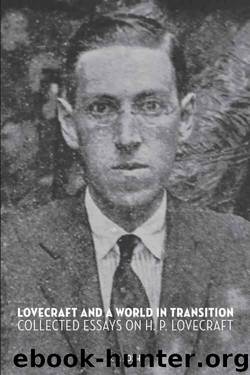
Author:S. T. Joshi
Language: eng
Format: mobi, epub
Publisher: Hippocampus Press
Published: 2015-01-26T05:00:00+00:00
IV. Studies of Individual Works
Who Wrote “The Mound”?
In Zealia Brown Reed Bishop’s oftentimes fantastic memoir, “H. P. Lovecraft: A Pupil’s View,” she declares expressly that Frank Belknap Long helped to revise a lengthy tale that Lovecraft ghostwrote for Bishop, “The Mound.” Yet both Long and Lovecraft were and have been ceaselessly stating that Lovecraft, and Lovecraft alone, wrote the novelette. As recently as 1975, Long stated categorically: “I had nothing whatever to do with the writing of The Mound” (Dreamer xiii–xiv). Who actually authored this tale, a major Lovecraftian opus fully as long as “The Whisperer in Darkness”?
Evidence shows that, although Long did indeed have a hand in the process of revision (or ghostwriting) of “The Mound,” he is nonetheless fundamentally correct when he states, “That brooding, somber, and magnificently atmospheric story is Lovecraftian from the first page to the last” (Dreamer xiv). However, behind this statement lies a wealth of detail that even yet is not completely unravelled. Indeed, the published versions of “The Mound” are certainly not Lovecraft’s in every respect.
Bishop had given Lovecraft the task of revising or ghostwriting “The Mound” in late 1929. R. H. Barlow states that “The Mound was . . . written by Lovecraft . . . from a late synopsis [by Bishop], something like ‘There is an Indian mound near here, which is haunted by a headless ghost. Sometimes it is a woman.’”[104] But Lovecraft found this plot-germ far too tame, and he began expanding it, incorporating into it many elements of his myth-cycle. He wrote to Elizabeth Toldridge: “Everything pertaining to the Mayan & Aztec civilisations is interesting, & I fancy I shall use the theme more than once. Indeed—my next revision job will give me a chance to practice, since it will require the introduction of this theme in such a way as to involve wholly original composition on my part” (Letters to Elizabeth Toldridge 114).
We next hear that the ghostwriting of “The Mound” is “proving to be rather an incubus, for the idea is spinning itself out into a veritable novelette” (SL 3.97–98). Evidently Lovecraft finished the entire tale in early 1930. It appears that he now handed on his autograph version of the tale to Long for typing, and that Long actually prepared the typed version: the typewriter face of the typescript and carbon copy (still surviving in the John Hay Library) is identical to that of letters by Long for this period. Moreover, Long seems to have made certain transcriptional errors in the text due to his inability to read Lovecraft’s handwriting; one word is rendered on the typescript as “atariousness,” and I have still not been able to ascertain what Lovecraft’s intention here was.[105] (Lovecraft’s handwritten manuscript has of course perished.) After the typescript was finished in 82 pages, it was submitted—either by Long (who at this time was Bishop’s major literary agent [see OFF 143]) or by Lovecraft—to Weird Tales, but editor Farnsworth Wright rejected it, presumably on account of its length; Long writes to Lovecraft (c.
Download
Lovecraft and a World in Transition: Collected Essays on H. P. Lovecraft by S. T. Joshi.epub
This site does not store any files on its server. We only index and link to content provided by other sites. Please contact the content providers to delete copyright contents if any and email us, we'll remove relevant links or contents immediately.
4 3 2 1: A Novel by Paul Auster(12360)
The handmaid's tale by Margaret Atwood(7744)
Giovanni's Room by James Baldwin(7313)
Asking the Right Questions: A Guide to Critical Thinking by M. Neil Browne & Stuart M. Keeley(5747)
Big Magic: Creative Living Beyond Fear by Elizabeth Gilbert(5735)
Ego Is the Enemy by Ryan Holiday(5404)
The Body: A Guide for Occupants by Bill Bryson(5067)
On Writing A Memoir of the Craft by Stephen King(4924)
Ken Follett - World without end by Ken Follett(4712)
Adulting by Kelly Williams Brown(4558)
Bluets by Maggie Nelson(4541)
Eat That Frog! by Brian Tracy(4508)
Guilty Pleasures by Laurell K Hamilton(4431)
The Poetry of Pablo Neruda by Pablo Neruda(4084)
Alive: The Story of the Andes Survivors by Piers Paul Read(4013)
White Noise - A Novel by Don DeLillo(3998)
Fingerprints of the Gods by Graham Hancock(3982)
The Book of Joy by Dalai Lama(3965)
The Bookshop by Penelope Fitzgerald(3838)
